 Queen Creek Fence Rental
 Construction Site Fencing in Queen Creek & San Tan Valley
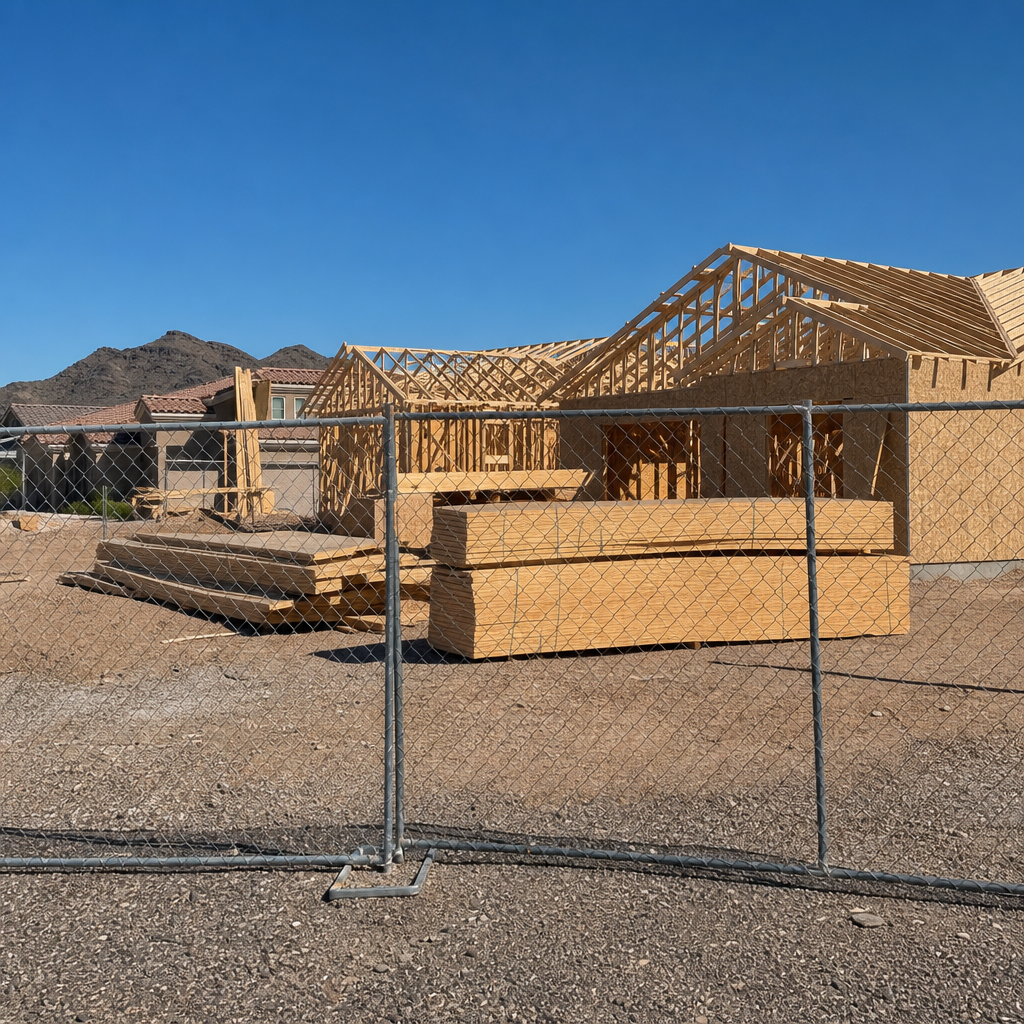
If you’re building in Queen Creek or San Tan Valley, you can have a secured chain-link perimeter around your site this week, typically for $1.50–$3.00 per linear foot per month, about $800–$3,000/month for most active job sites. We deliver, install, and remove the fence on your schedule; ask us to quote the whole thing up front so there are no surprise line items at pickup.
Why job sites here get fenced first, not last
Queen Creek is the fastest-growing town in Arizona: up 8.2% in a single year to roughly 89,770 people, and up 51.4% since 2020. That growth shows up as open trenches, staged lumber packages, and $40,000 worth of copper and appliances sitting on slabs from Barney Farms at Queen Creek Road and Signal Butte to Harvest at Riggs and Rittenhouse. Across the county line, San Tan Valley incorporated in 2025 with more than 100,000 residents and its own pipeline of new communities like Soleo.
That much active construction in one corridor attracts theft crews who work it like a route. An unfenced site is the easy stop on that route. A fenced one usually isn’t worth the time. Fencing is also the first thing an OSHA visit, a superintendent walk, or a neighboring HOA board looks at, open excavations next to occupied homes in a half-built subdivision are a liability problem before they’re anything else.
Here’s what a perimeter actually does for you:
- Theft and vandalism deterrence for lumber drops, wire, tools, and fuel
- Liability control: kids on bikes and curious neighbors stay off open trenches and rebar
- Trade discipline: one gate means deliveries, porta-johns, and dumpsters land where you planned
- Inspection optics: a clean, fenced site reads as a managed site
What a typical install includes
Standard construction perimeters use freestanding 12-foot chain link panels on sandbag-ballasted feet, no post driving, no concrete, no damage to finished flatwork or ABC base. Panels clamp together into any run length and turn corners cleanly. If your spec calls for it, ask for:
- Vehicle and pedestrian gates sized for concrete trucks, lumber deliveries, and crew access
- Windscreen for dust visibility and sightline control. See our privacy screen and windscreen page
- Extra ballast on exposed desert-edge runs where monsoon outflows hit hardest
For a deeper look at the panels themselves, dimensions, feet, clamps, see chain link fence panels.
Chain link panels vs. water-filled barriers, and other spec questions
Estimators pricing a bid sometimes ask whether water-filled plastic barriers can do the fence’s job. They can’t. They’re different tools. A water-filled barrier is a traffic-control device: waist-high, orange or white, engineered to absorb a vehicle strike on a lane or shoulder closure. Anyone can step over one in a second, so it does nothing for theft, trespass, or open-trench liability. If your project fronts Ellsworth, Ironwood, or a torn-up collector street, your traffic-control plan may well call for water-filled barrier at the roadway, and your site will still need 6-foot chain link behind it. Plenty of road-adjacent jobs here run both at once.
Height questions land the same way: 6-foot panels are the standard security spec and what superintendents and insurance carriers expect on an active site. The one place a different number matters is a pool inside your project: ARS 36-1681 sets gate and gap rules for the finished pool, and the inspector decides what applies during construction, covered on the temporary pool fencing page.
Two more spec items worth settling before the quote. If your fence line or a closure pushes pedestrians off a public sidewalk, the temporary route has to stay ADA-compliant: level surface, adequate clear width, gates without protruding hardware at pedestrian pass-throughs; raise it when you request a quote, and flat-foot barricades handle sidewalk detours. And on bases: the common standard here is freestanding sandbag-ballasted feet rather than post-driven fence, which skips the Arizona 811 locate wait and leaves flatwork intact. The full comparison is on the chain link fence panels page.
Construction fence rental pricing in Queen Creek
| Site type | Typical footage | Monthly rate |
|---|---|---|
| Single custom-home lot | 300–500 ft | $450–$1,500 |
| Pool build / backyard remodel | 100–200 ft | $150–$500 |
| Subdivision phase perimeter | 1,000–2,000 ft | $1,500–$3,000+ |
| Commercial pad site | 600–1,200 ft | $900–$3,000 |
| Delivery, install & removal | one-time | $100–$500 |
Rates land at $1.50–$3.00 per linear foot per month depending on total footage, term length, gate count, and windscreen. Longer terms price at the low end. Full breakdowns are on our pricing page.
Dust control: Rule 310 and the Pinal County side
Most of Queen Creek sits in Maricopa County, where Rule 310 governs fugitive dust on construction sites: permits, control plans, track-out prevention, the works. Sites in San Tan Valley, Florence, and the Superstition Vistas area fall under Pinal County’s dust rules instead, and Pinal is its own nonattainment area for PM-10, so inspectors are active on both sides of the line.
Straight talk: a rental fence is not a listed dust control measure, and we won’t pretend it is. But windscreen mounted on your fence line knocks down wind-driven dust at the perimeter, keeps blowing trash on-site, and signals to any inspector driving Ellsworth or Hunt Highway that the site is managed. GCs running phases in both counties often standardize on screened perimeters for exactly that reason.
Monsoon season changes the install
From roughly June 15 through September 30, outflow winds ahead of monsoon storms routinely gust 40–60 mph across the East Valley, and microbursts can exceed that. A fence that stands all winter can go down in one July evening if it was ballasted for winter.
A monsoon-season standard worth asking for:
- Sandbag ballast on every panel foot, doubled on open desert exposures, common on San Tan Valley and Florence sites where there’s nothing between the fence and the wind for a mile
- Windscreen honestly assessed, screen adds sail area, so screened runs get extra ballast, or we advise furling before major storm days
- Storm re-sets: if a storm knocks panels over on a properly maintained line, standing it back up is usually the rental company’s cost; confirm that in writing with whoever you rent from, us included
Gate planning: the part most site plans get wrong
Footage is easy, gates are where fence layouts succeed or fail. Before you request a quote, think through three questions:
- What’s the biggest vehicle that enters daily? A concrete pump truck needs more swing room than a crew truck. Size vehicle gates to the actual traffic, and a 20-foot double gate costs little more than an undersized one that gets “temporarily” dismantled by the framing crew and never properly closed again.
- Where does track-out control live? Under Rule 310, your stabilized construction exit needs to line up with the gate. Put the gate where the rock entrance is, not where it looks tidy on the plat.
- Who locks up? One gate with one chain gets locked every night. Four gates with four chains means one of them is open Saturday morning. Fewer, better-placed gates beat more gates.
If your site logistics change mid-project, they will, moving a gate is usually a quick quoted visit, not a redesign.
Service area
We cover the whole southeast Valley growth corridor: San Tan Valley from Johnson Ranch to Combs Road, Apache Junction including the Superstition Vistas builds, Gold Canyon, and Florence. If your project is along SR-24, Ironwood, Ellsworth, or Hunt Highway, you’re in the core service area; tell us your needed-by date and we confirm the install date with the quote.
How the rental works
- Quote. Send your footage (or just the address; we can measure from the plat), gate count, and term. Ask for one number covering delivery, install, rental, and removal.
- Install: our crew sets panels, ballast, and gates, usually in a half day for residential sites.
- Adjust, phases move, fences move. Ask for re-stages to be quoted per move, not hidden in fees.
- Removal. Call us when the site’s done. Pickup includes everything, sandbags too.
Building a pool as part of the project? Arizona’s pool barrier statute governs the finished pool and has no construction-phase rule, so ask the inspector at permit what the build needs. See temporary pool fencing before your gunite date, not after.
Send us the site address and we’ll turn a quote around quickly.
Frequently Asked Questions
How much does construction site fencing cost in Queen Creek?
Most Queen Creek job sites run $1.50–$3.00 per linear foot per month, which works out to roughly $800–$3,000 per month for a typical residential subdivision phase or commercial pad. Delivery, installation, and removal typically add $100–$500 total depending on footage and access.
How fast can fencing go up on a site in San Tan Valley?
Lead time depends on footage and the season; give us your needed-by date and we confirm the install date with your quote. San Tan Valley sites off Hunt Highway, Gantzel, and Combs are a short haul from Queen Creek, so travel time rarely slows the schedule.
Does temporary fencing help with Maricopa County Rule 310 dust compliance?
Fencing itself isn't a dust control measure, but adding windscreen to the fence line reduces track-out visibility and wind-driven dust at the perimeter, and inspectors notice a buttoned-up site. Your dust permit and control plan still do the heavy lifting, the fence and screen support them.
Will rented fence panels survive an Arizona monsoon storm?
Panels installed with proper sandbag ballast handle typical monsoon outflow winds. Before a forecast microburst we recommend doubling ballast on exposed runs and removing or furling windscreen, which acts like a sail. Ask us, or anyone quoting, how the line gets ballasted for monsoon season, June through September.
Can fencing be rented for long-term projects, 6 months or more?
Yes. Multi-phase subdivision work is a big share of temporary fence rental here, and monthly rates usually drop on longer commitments. Ask us to re-stage the fence line as your phases move, so you're not paying to fence dirt you've already delivered.
Can water-filled barriers replace chain link fencing on a job site?
No, they solve different problems. Water-filled plastic barriers are traffic-control devices for lane and shoulder closures: waist-high, made to take a vehicle strike, and easy to step over, so they do nothing for theft or liability. Site security is 6-foot chain link work. Road-adjacent projects often need both, with the barriers spec'd by the traffic-control plan.